





Boat Trailer Bunk Guide: A Comprehensive Overview
Navigating the world of boat trailers and bunks can be complex, but essential for safe transport and easy launching. This guide provides
detailed insights into bunk trailer systems, covering setup, maintenance, and specific boat type configurations for optimal performance and longevity.
Understanding Boat Trailer Bunks
Boat trailer bunks are the unsung heroes of safe and efficient boat transportation. They provide crucial support to the hull, distributing the boat’s weight evenly across the trailer frame. Unlike roller trailers, bunks offer a larger contact surface, minimizing stress points and potential damage during travel.
Understanding how bunks function is paramount for boat owners. They aren’t simply passive supports; proper adjustment and maintenance are vital; The goal is to cradle the hull, mimicking how it sits in the water, ensuring a secure fit. This prevents shifting during transit, which can lead to scratches, dents, or even structural issues.
Target bunks, a specialized type, further enhance this process by guiding the boat onto the trailer with precision, simplifying launching and retrieval, especially in challenging conditions. Choosing the right bunk material – carpeted or non-carpeted – also impacts performance and hull protection, a detail we’ll explore further.
What are Boat Trailer Bunks?
Boat trailer bunks are longitudinal supports running along the length of a boat trailer, designed to hold the boat’s hull. Typically constructed from treated lumber or aluminum, they are covered in carpet (though non-carpeted options exist) to protect the gelcoat and provide grip. These supports are mounted to adjustable brackets, allowing for customization based on the boat’s hull shape.
Unlike roller trailers which use wheels, bunks support the boat along a substantial portion of its hull. This distributed support minimizes stress and prevents concentrated pressure points. Bunks are commonly used in conjunction with a winch system at the bow for secure loading and transport.
“Target bunks” are a specific type designed to guide the boat during loading, ensuring proper alignment and simplifying the process, particularly in less-than-ideal conditions; They act as a funnel, directing the boat onto the trailer with minimal effort.
Benefits of Using Bunk Trailers
Bunk trailers offer several advantages over roller trailers, primarily centered around hull support and ease of use. The extensive contact area provided by bunks distributes the boat’s weight evenly, reducing stress points and minimizing the risk of hull damage during transport. This is particularly beneficial for fiberglass hulls.
Loading and launching are often simplified with bunk trailers, especially when utilizing “target bunks” which actively guide the boat onto the trailer. This reduces the need for precise maneuvering, a significant benefit in crowded marinas or challenging weather.
Bunk trailers generally require less maintenance than roller trailers, as there are fewer moving parts to lubricate or replace. They also tend to be quieter during transport, eliminating the rattling associated with rollers. Properly adjusted bunks contribute to a smoother, more stable towing experience.
Types of Bunk Materials
Boat trailer bunks are commonly constructed from either wood or specialized composite materials, each offering distinct characteristics. The choice often depends on budget, boat size, and desired longevity.
Carpeted Bunks are a popular option, providing excellent grip and cushioning for the hull. The carpeting helps prevent scratches and distributes pressure. However, carpeted bunks require regular cleaning to prevent mildew and algae growth, and the carpet itself will eventually wear down, necessitating replacement.
Non-Carpeted Bunks, typically made from pressure-treated lumber or durable plastics, offer a lower-maintenance alternative. While they may not provide the same level of cushioning, they are less prone to water damage and require minimal upkeep. Some owners choose to add slick sleeves over non-carpeted bunks to aid in launching and retrieval.
Carpeted Bunks
Carpeted boat trailer bunks represent a widely favored choice among boat owners due to their superior hull protection and enhanced grip. The carpet layer acts as a crucial buffer, minimizing the risk of scratches, abrasions, and potential damage to the boat’s gel coat during loading and transport.
The textured surface of the carpet provides excellent traction, ensuring the boat remains securely positioned on the trailer, even on inclines or during bumpy rides. This is particularly beneficial for preventing shifting during travel. However, carpeted bunks demand consistent maintenance. Regular cleaning is vital to combat mildew, algae, and the accumulation of dirt and debris.
Over time, the carpet will inevitably wear down, losing its cushioning and grip. Replacement is necessary to maintain optimal performance and protect the boat’s hull effectively.
Non-Carpeted Bunks
Non-carpeted boat trailer bunks, typically constructed from wood or durable plastic, offer a streamlined and low-maintenance alternative to their carpeted counterparts. These bunks prioritize simplicity and ease of cleaning, making them appealing to boaters seeking a hassle-free solution.
While they lack the inherent cushioning of carpeted bunks, non-carpeted options can still provide adequate support when properly adjusted and maintained. It’s crucial to ensure a smooth surface to prevent potential hull damage during loading and transport. Regular inspection for splinters or rough edges is essential.
Lubrication is key with non-carpeted bunks, using boat soap or specialized bunk lubricants to facilitate smoother launching and retrieval. They are often preferred for boats with simpler hull shapes or those frequently used in saltwater environments, where carpet degradation is a concern.
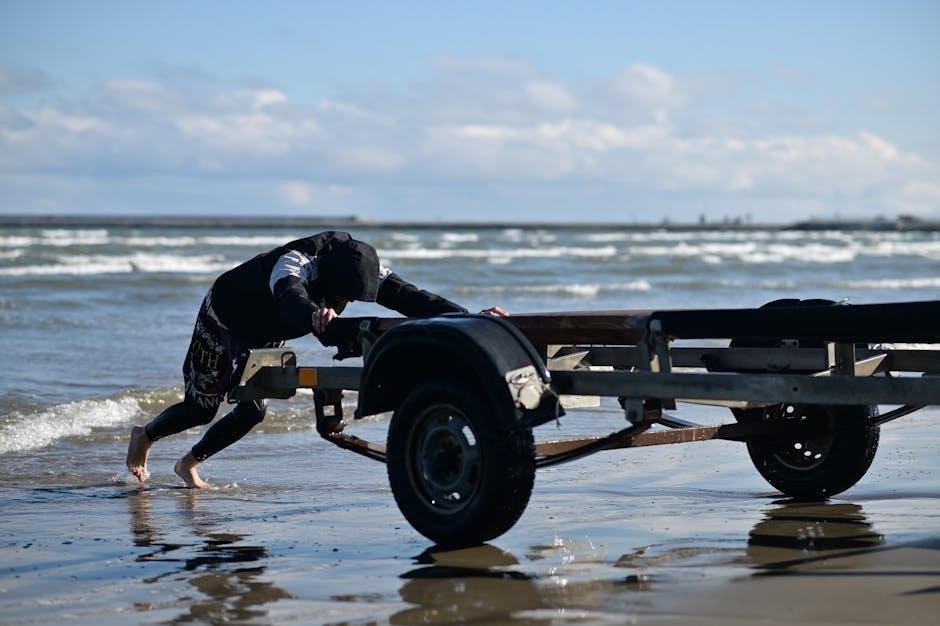
Bunk Trailer Setup & Adjustment
Proper bunk trailer setup is vital for secure boat transport and effortless launching. Precise height, angle, and positioning ensure optimal hull support and prevent damage during travel.
Initial Bunk Positioning: Key Considerations
When initially positioning bunks, prioritize aligning them with your boat’s hull shape for balanced support. Consider the boat’s center of gravity and distribute weight evenly across the bunks. Begin by setting the shorter bunks as outer supports, running parallel to the chine, and keeping them as low as possible.
Longer, inner bunks should be positioned approximately a foot apart, centering them along the hull’s keel or running pad, if applicable. For Jon boats, a three-pair mount configuration – back, center, and front – often works well, locking the rear pair at the correct transom angle while leaving the front pivots slightly loose for adjustments.
Remember to thoroughly wet the bunks before loading the boat; this reduces friction and facilitates proper positioning. Adding weight distribution, like trolling motor batteries in the front, can further refine the setup. Careful initial positioning minimizes stress and ensures a secure, damage-free journey.
Setting Bunk Height for Optimal Support
Achieving optimal bunk height is crucial for preventing hull distortion and ensuring a secure fit. The goal is to support the boat’s hull along its structural members, avoiding concentrated pressure points. Start with the bunks set as low as possible, allowing the hull to settle naturally onto them.
Gradually adjust the height, ensuring consistent contact along the hull’s lines. Avoid lifting the boat excessively, as this can create stress. For boats with running pads, accommodate the pad’s shape when setting bunk height. Target bunks, when used, should guide the boat onto the main bunks, minimizing the need for precise height adjustments.
Regularly inspect the hull for any signs of uneven pressure or deformation. Proper bunk height distributes the boat’s weight effectively, contributing to a smoother, safer towing experience and protecting your investment.
Adjusting Bunk Angle for Hull Shape
Matching the bunk angle to your boat’s hull shape is vital for proper support and preventing damage during transport. V-hull boats require bunks angled to mirror the hull’s contours, providing even weight distribution. Jon boats and skiffs, with flatter hulls, generally need less aggressive angling.
Begin by setting the rear bunk angle to match the transom angle, locking it securely. Allow the front bunk pairs to pivot slightly loose initially, enabling the boat to self-center as it’s loaded. Wetting the bunks reduces friction, facilitating smooth loading and accurate alignment.
Fine-tune the angle by observing how the hull contacts the bunks. Ensure full, consistent support without excessive pressure on any single point. Correct angling minimizes stress and ensures a stable ride during towing.
Target Bunk System Explained
Target bunks are a valuable addition to boat trailers, designed to simplify launching and retrieval, particularly in challenging conditions. These specialized bunks act as guides, directing the boat onto the trailer with precision, reducing the need for extensive maneuvering.
The primary purpose of target bunks is to provide a defined path for the boat, allowing the operator to drive straight onto the trailer. Once the boat contacts the target bunks, it can be driven forward to the winch roller, streamlining the process.
Installing target bunks typically involves adding brackets to the trailer frame and mounting adjustable bunk boards. Proper alignment with the boat’s hull is crucial for effective guidance. They work exceptionally well when combined with properly adjusted standard bunks.
Purpose of Target Bunks
The core function of target bunks is to dramatically ease the often-stressful process of boat launching and retrieval. For boat owners, especially those navigating crowded marinas or slippery ramps, these bunks offer a significant advantage in control and efficiency.
Target bunks serve as guiding rails, ensuring the boat tracks straight onto the trailer, minimizing the risk of misalignment or damage. This is particularly helpful in windy or current-affected conditions where precise steering can be difficult.
They effectively eliminate much of the guesswork involved in lining up the boat with the trailer, allowing for a smoother, faster, and safer loading experience. Ultimately, target bunks reduce frustration and potential for costly mistakes during launch and retrieval operations.

Installing Target Bunks
Proper installation of target bunks is crucial for realizing their full benefits. Begin by securely attaching new brackets, ensuring they are aligned to guide the boat precisely towards the winch and roller. Existing target bunks can be utilized, but bracket condition should be carefully assessed.
Position the bunks strategically to correspond with the boat’s hull shape and stringer locations. A common approach involves placing them directly beneath the hull’s stringers for optimal support. Adjustments to bracket placement may be necessary to achieve a perfect fit.
Once brackets are secure, ensure the bunks are firmly mounted and can withstand the boat’s weight during loading. Wetting the bunks before loading the boat helps facilitate smooth alignment and reduces friction. Regular inspection of mounting hardware is vital for continued safety.
Bunk Maintenance & Care
Consistent bunk maintenance extends their lifespan and ensures optimal boat support. Regular cleaning, damage inspection, and component replacement are vital for smooth launching and retrieval.
Cleaning Bunk Carpeting
Maintaining clean bunk carpeting is crucial for preventing mildew, algae growth, and ensuring a secure grip for your boat. After each use, especially in saltwater environments, thoroughly rinse the carpeting with fresh water to remove salt, debris, and grime. A mild soap solution can be used for more stubborn stains, but avoid harsh chemicals that could damage the carpet fibers or leach into the water.
Allow the carpeting to air dry completely before covering or storing the boat. Regular scrubbing with a stiff brush can help dislodge embedded dirt and restore the carpet’s texture. Consider using a carpet cleaner specifically designed for marine applications for a deeper clean. Inspect the carpeting for any tears or loose fibers and repair them promptly to prevent further damage. Proper cleaning not only extends the life of the bunk carpeting but also contributes to the overall health and longevity of your boat trailer system.
Inspecting Bunk Boards for Damage
Regularly inspecting bunk boards for damage is paramount to ensuring continued boat support and preventing costly repairs. Examine the boards for signs of rot, cracking, warping, or delamination, particularly in areas that are consistently exposed to moisture. Pay close attention to the edges and corners, as these are often the first areas to show wear.
Probe the wood with a screwdriver to check for soft spots, indicating internal decay. If any damage is detected, replace the affected boards immediately. Ignoring even minor damage can lead to structural failure and potential boat damage during transport. Consider applying a wood preservative to help protect the bunk boards from the elements and extend their lifespan. A proactive inspection routine will safeguard your investment and provide peace of mind on the road.
Replacing Worn Bunk Components
When bunk components show significant wear or damage, replacement is crucial for maintaining optimal boat support and safe trailering. Begin by removing the old bunk boards, carefully disconnecting any mounting hardware. Ensure the new boards are the correct length and width for your trailer and boat.
When installing new boards, use corrosion-resistant bolts and hardware. Consider using stainless steel for longevity. Re-attach the boards securely, ensuring they are properly aligned and tightened. If replacing carpet, apply a marine-grade adhesive and ensure a smooth, wrinkle-free finish. Don’t forget to inspect and replace any worn bunk brackets or mounting hardware during this process. Proper replacement guarantees a secure and reliable bunk system, protecting your boat during transport.
Lubrication for Smooth Launching
Applying lubricant to the bunk surfaces significantly eases the launching and retrieval process, reducing friction and preventing potential damage to your boat’s hull. A silicone-based lubricant is highly recommended, as it’s water-resistant and won’t attract dirt or grime.
Before each launch, generously spray the entire length of the bunks, ensuring complete coverage. This creates a slick surface allowing the boat to glide smoothly on and off the trailer. Regularly reapply lubricant, especially after saltwater exposure or frequent use. Consider lubricating the winch cable and trailer rollers as well for a comprehensive smooth operation. Proper lubrication minimizes stress on the bunks and hull, extending their lifespan and simplifying the boating experience.
Specific Boat Types & Bunk Configuration
Different boat hulls require tailored bunk setups for optimal support and secure transport. Understanding these nuances ensures proper weight distribution and prevents damage during travel.
Jon Boat Bunk Setup
Jon boats, with their flat bottoms, present a unique challenge for bunk trailer configuration. A common approach involves utilizing longer bunks running nearly the full length of the hull, often with three pairs of mounts – front, center, and rear.
The rear pair should be locked at the correct transom angle, providing a stable base. The front pairs are typically left with slightly loose pivots, allowing for adjustments as the boat settles.
Thoroughly wetting the bunks before loading is crucial; this reduces friction and facilitates smooth loading, especially with the added weight of trolling motor batteries positioned towards the bow.
Outer bunks, parallel to the chine, set as low as possible, combined with inner, longer bunks spaced approximately a foot apart in the center, offer excellent support. Remember to accommodate any running pads present on the hull.
Aluminum Boat Bunk Considerations
Aluminum boats often require careful bunk setup due to the material’s susceptibility to damage and the varying hull shapes. Ensuring proper support is vital to prevent hull distortion during transport. Similar to Jon boats, longer bunks are frequently recommended, providing a more substantial contact area.
Pay close attention to the hull’s strakes or keels; bunks should align with these features for optimal weight distribution. Adjusting bunk height is critical – too high, and the boat may rock excessively; too low, and it could scrape during loading.
Consider using carpeted bunks to minimize abrasion and provide a softer contact surface. Regularly inspect the bunks for wear and tear, replacing components as needed to maintain adequate support and prevent damage to the aluminum hull.
Proper lubrication of the bunks will also aid in smoother loading and launching, reducing stress on both the boat and the trailer.
V-Hull Boat Bunk Adjustments
V-hull boats present unique bunk adjustment challenges due to their curved hull shape. Achieving a balanced and secure fit requires precise bunk positioning and angling. The primary goal is to distribute the boat’s weight evenly along the bunks, preventing stress points and potential hull damage.
Start by setting the outer bunks parallel to the chine, ensuring they follow the hull’s curve. The inner bunks should then be adjusted to support the keel or the highest point of the V. Adjusting the bunk angle is crucial; it should mirror the hull’s deadrise for optimal contact.
Target bunks are particularly helpful for V-hulls, guiding the boat onto the trailer and ensuring consistent positioning. Regularly check bunk height and angle, especially after long journeys, to maintain proper support.
Remember to lubricate the bunks for easier loading and unloading, minimizing friction and potential scratches.
Skiff Bunk Positioning
Skiffs, often featuring flatter hulls, require a slightly different bunk positioning strategy compared to V-hulls. The focus is on providing broad, even support across the hull’s bottom, preventing localized pressure points. A common approach involves utilizing shorter, outer bunks aligned with the chine and longer, inner bunks positioned centrally.
These inner bunks should be spaced approximately a foot apart, accommodating any running pads or keel features. Setting the bunks as low as possible maximizes stability and simplifies loading. Ensure the bunks are firmly secured to the trailer frame to prevent shifting during transport.
Consider the skiff’s weight distribution when adjusting bunk placement; heavier components like the engine or batteries may necessitate adjustments for balanced support. Regular inspection and lubrication are vital for smooth launching and retrieval.

Troubleshooting Common Bunk Issues
Addressing issues like tracking problems, launch difficulties, or bunk wear is crucial for maintaining a functional trailer system. Identifying the root cause ensures safe boating experiences.
Boat Not Tracking Straight on Bunks
If your boat consistently drifts to one side while loading onto the trailer bunks, several factors could be at play. First, meticulously inspect the bunk alignment; ensure they are parallel to the boat’s centerline and each other. Uneven bunk height is a common culprit, causing the boat to favor the lower side.
Adjust bunk height incrementally, focusing on the side the boat drifts towards, raising it slightly. Also, verify the trailer itself is level. A tilted trailer exacerbates tracking issues. Consider the wind; strong crosswinds can push the boat off course during loading.
Finally, examine the bunks for wear or damage – uneven carpeting or compressed boards can create inconsistent support. Wetting the bunks thoroughly can also aid in straight tracking, reducing friction and allowing the boat to settle evenly. Remember to double-check all adjustments before each launch.
Difficulty Launching/Retrieving
Struggling to launch or retrieve your boat can be incredibly frustrating, often stemming from bunk-related issues. Insufficient lubrication is a primary cause; generously apply boat trailer lubricant to the bunks before each launch or retrieval. Ensure the bunks are properly positioned to support the boat’s hull shape – incorrect angles create excessive friction.
If the boat is stuck, avoid excessive engine power; this can damage the drive unit. Instead, gently rock the boat back and forth while slowly reversing the trailer. Target bunks, when properly installed, significantly ease this process by guiding the boat towards the winch.
Check for obstructions between the hull and bunks, like debris or tangled straps. Finally, confirm the trailer is submerged deep enough for a smooth launch, and that the winch cable is securely fastened during retrieval.

Bunk Wear and Tear Solutions
Over time, boat trailer bunks inevitably show wear and tear, requiring proactive solutions to maintain optimal performance. Regularly inspect bunk boards for rot, cracks, or delamination; replace damaged boards immediately to prevent further hull damage. For carpeted bunks, address fraying or loose carpeting with patching or full replacement, ensuring a smooth surface.
Worn bunk brackets can cause misalignment; tighten or replace them as needed. Consider upgrading to heavier-duty brackets for increased support, especially for larger boats. When replacing components, use marine-grade materials to resist corrosion and extend lifespan.

Proper cleaning and lubrication, as detailed in the maintenance section, significantly reduce wear. Addressing minor issues promptly prevents costly repairs and ensures continued safe boat transport.